
Start the Conversation Early.
Grown-Ups Toolkit
Welcome! You’re here because you care about the children in your life, and you want to keep them safe, confident, and supported. This toolkit is designed to make important safety conversations simple, calm, and doable, for every grown-up, in every setting!
Families come in all forms, and every child, regardless of background, gender, ability, or family structure, deserves safety, respect, and support. It’s important to have these conversations, even if we think our children won’t need them.
This toolkit offers simple, age-appropriate ways to talk with kids about body safety, boundaries, feelings, and identifying safe grown-ups.
You do not need special training to use this.
You do not need the perfect words.
You just need empathy, patience, and the willingness to listen.
Used alongside the coloring pages, these short conversations can help prevent violence, increase help-seeking, and support healing.
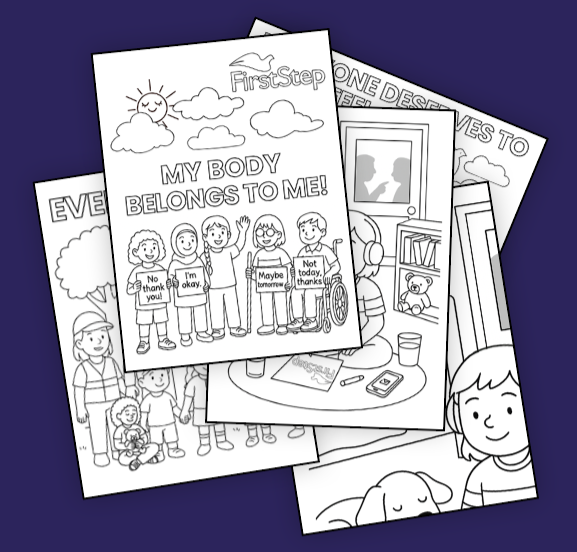
Download Coloring Sheets (PDF)
 (opens in a new tab)
Request a School/Youth Presentation
Start here☎️
Need help now? Call First Step's
24-Hour Helpline: 734-722-6800
If you or a child is in immediate danger, call 911.What you’ll find in this toolkit:
Click to jump ahead
- How to start short, calm, repeatable conversations with kids
- A quick language guide by developmental age
- Mini guides for each coloring page
- What to do (and say) if a child discloses abuse, harm, or neglect
- Quick one minute scripts
- Red flags to look out for
- Why support matters
- Where to get help in Wayne County and beyond
- Bring First Step to your organization

CORE PRINCIPLES FOR EVERY CONVERSATION
Why these talks matter
Children who learn body safety, boundary-setting, and how to ask for help are more likely to reach out, disclose harm, and avoid unsafe situations. Kids who can name feelings, body parts, and safe grown-ups have more opportunities for early intervention and healing.
When to talk
- Calm, ordinary moments during coloring, car rides, bath time, bedtime, walks
- Avoid pressured moments, after conflict, or on rushed days
- Repeat small conversations over time – these are not intended to be a one-time “big talks”
How to talk
- Use age-appropriate, non-scary and simple language
- Ask open questions
- Listen more than you speak; silence gives space for children to think
- Use short, repeatable phrases; revisit often
- You don’t have to “fix” everything in the moment; stay calm
Safety & care
If a child shares something concerning or scary:
✔ Believe them
✔ Thank them for telling you
✔ Tell them it’s not their fault
✔ Explain the next step: “My job is to help keep you safe.”
(Reporting guidance and resources are listed at the end of this toolkit.)
Language tips
- Use real names for body parts (it increases safety and disclosure)
- Normalize saying “no” and hearing “no”
- Avoid shame language (e.g., “bad girl/boy,” “naughty”)
- Give choices (talk, draw, fidget, take breaks)
(Suggested language for various age groups can be found next in the toolkit)
Accessibility & inclusion
- Allow kids to move or color while talking
- Use visual choices when words are hard
- Avoid assumptions about family, gender, or culture
- Every child deserves safety, support, and respect
🧑🧑🧒
AGE-APPROPRIATE LANGUAGE AND CONCEPTS
Understanding Key Safety Concepts
Children learn best when adults use consistent words and simple definitions. These are the building blocks of your conversations:
Concept |
How to Explain It to a Child |
Why It Matters |
| Consent | “We can say ‘yes’ or ‘no’ to touch. We listen when others say ‘no.’” | Builds respect and body autonomy; prevents coercion. |
| Body Safety | “We keep our bodies safe just like we wear helmets while riding a bike or looking both ways before crossing the street.” | Normalizes body safety as an everyday skill, not a scary topic just in relation to sexual violence. |
| Boundaries | “Boundaries are the rules we make about our body, space, and feelings. We don’t have to do things we don’t want unless it’s for safety, health, or cleanliness and with a safe grown-up.” | Teaches self-awareness and respect for others’ comfort zones. |
| Safe Grown-Ups | “Safe grown-ups are adults who listen, believe, and help us feel safe, like parents, teachers, counselors, or other helpers.” | Helps children identify trusted adults before a crisis happens. |
| Private Parts | “Private parts are the body parts covered by a bathing suit. No one should touch or look at them unless they’re a safe grown-up helping us stay clean or healthy.” | Builds vocabulary for safety and supports accurate disclosure. |
Tip: “Private parts” works for young children, but using real words like penis, vulva, breasts, and buttocks improves clarity and safety. You can use both: “That’s your vulva, it’s a private part, and it belongs to you.”
Using These Concepts in Conversation:
Topic |
Ages 2–5 |
Ages 6–10 |
Ages 11–13 |
Ages 13+ |
|
Consent |
“We ask before hugs.” |
“You can say yes or no to touch.” |
“You don’t owe anyone touch or attention.” |
“Consent must be freely given, every time.” |
|
Body Safety |
“Private parts stay private.” |
“No one gets to touch or see your private parts except for health/help.” |
“Your body belongs to you; no one can pressure you.” |
“Boundaries apply in dating, friendships, school, online.” |
|
Boundaries |
“Stop means stop.” |
“You can move away and tell a grown-up.” |
“You are allowed to leave uncomfortable situations.” |
“Healthy relationships respect boundaries.” |
|
Safe Grown-Ups |
“Grown-ups who keep us safe.” |
“Adults who listen, believe, and help.” |
“If one grown-up doesn’t listen, tell another.” |
“Trust your instincts, keep telling until someone helps.” |
|
Private Parts |
“Private parts.” |
“Private parts.” |
“Genitals and breasts.” |
“Genitals and breasts.” |
Note: These are just suggestions and not rules. All children develop differently. Use what fits their age, understanding, and needs.
What to say (AND Do) When a child discloses
Empathetic Responses to Disclosures:
- “Thank you for telling me.”
- “You did the right thing.”
- “I’m sorry this happened.”
- “It’s not your fault.”
- “My job is to help keep you safe.”
Do:
- Stay calm, your reaction matters
- Ask open questions: “Can you tell me what happened?” “Who was there?” “Where do you feel safe right now?”
- Ask only the minimum you need to keep them safe; leave the detailed questions to trained professionals
- In kid friendly language, tell them the steps you have to take next in order to keep them safe
- Contact support (First Step, school counselor, doctor, etc.)
- Document what you see or hear later (quotes, dates); not in front of the child
Avoid:
- “Are you sure?”
- “Why didn’t you say something sooner?”
- Promising secrecy
- Asking leading questions
- Showing shock, anger, or panic
- Asking them to repeat their story to multiple non-professionals
Instead of… / Try this
|
Instead of… |
Say… |
|
“Are you sure?” |
“I believe you. Thank you for telling me.” |
|
“Why didn’t you tell me before?” |
“It can be hard to talk about this. I’m glad you told me now.” |
|
“We’ll keep this secret.” |
“Some things can’t be secret because safety is important, but I will only tell the helpers we need.” |
|
Ignoring it. |
“When something bothers you, your feelings matter. Let’s figure out the next step together.” Or “What you just shared makes me sad, and I need to be sure you are safe. Let’s figure out the next steps together.” |
Reporting Suspected or Alleged Child Abuse or Neglect (Michigan)
If you suspect child abuse or neglect by a caregiver, you can make a report online 24/7 at:
Michigan Online Reporting System (MORS): https://mdoe.state.mi.us/MORS
You can also call 855-444-3911 (Michigan CPS Hotline).
For abuse by non-caregivers (peers, relatives, neighbors, teachers, coaches, etc.), contact your local police department and First Step (for concerns related to intimate partner and/or sexual violence), Kids Talk, or The Children’s Center for guidance and support.
Not in or near Wayne County? Visit mcedsv.org/resources to find a domestic and sexual assault services provider near you.
🖍️
COLORING PAGE-BY-PAGE MINI-GUIDES
Though each of these coloring sheets can simply be used as just a fun activity, they also double as doorway into important conversations.
Below are goals/purposes of each sheet, suggested conversation starters, and responses related to each coloring pages topic.
Choose one coloring page at a time, read the short guide, and start with 1-2 questions. Small conversations add up.
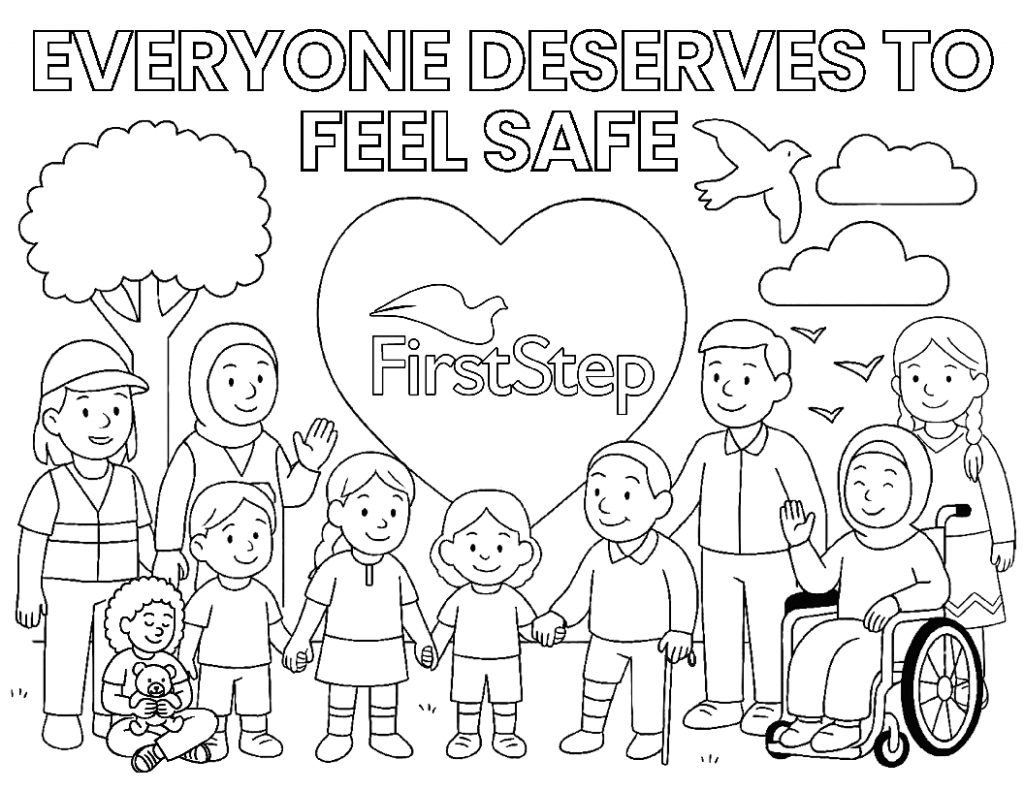
1) Everyone Deserves to Feel Safe
Purpose:
Belonging, empathy, inclusion
When:
Any age; before community events, field trips, sports, new groups. It is also just fun to introduce the series and get comfortable talking together while coloring!
Goals:
✔ Child names 3 places/people that feel safe
✔ Child can name 1 way to help others feel safe
Prompts:
- “What do you notice first in this picture?,” “Can you point to helpers in this picture?”
- Answers: Person behind the wheelchair, person holding hands of others, person who has hand on the back of the person with the cane
- “Who are helpers in our life?”
- “If someone new joined your group today, what could we do to help them feel welcome?,” “How could we help a friend feel safe today?” or “What can you do if someone looks sad or scared?”
- Answers: Sit together, get a grown-up, use kind words and say something nice, ask to play or if they’d like a hug (“What if they say ’no?’” See “My Body Belongs to Me” for conversations around consent.)
- “What makes you feel safe” or “What makes you feel scared?”
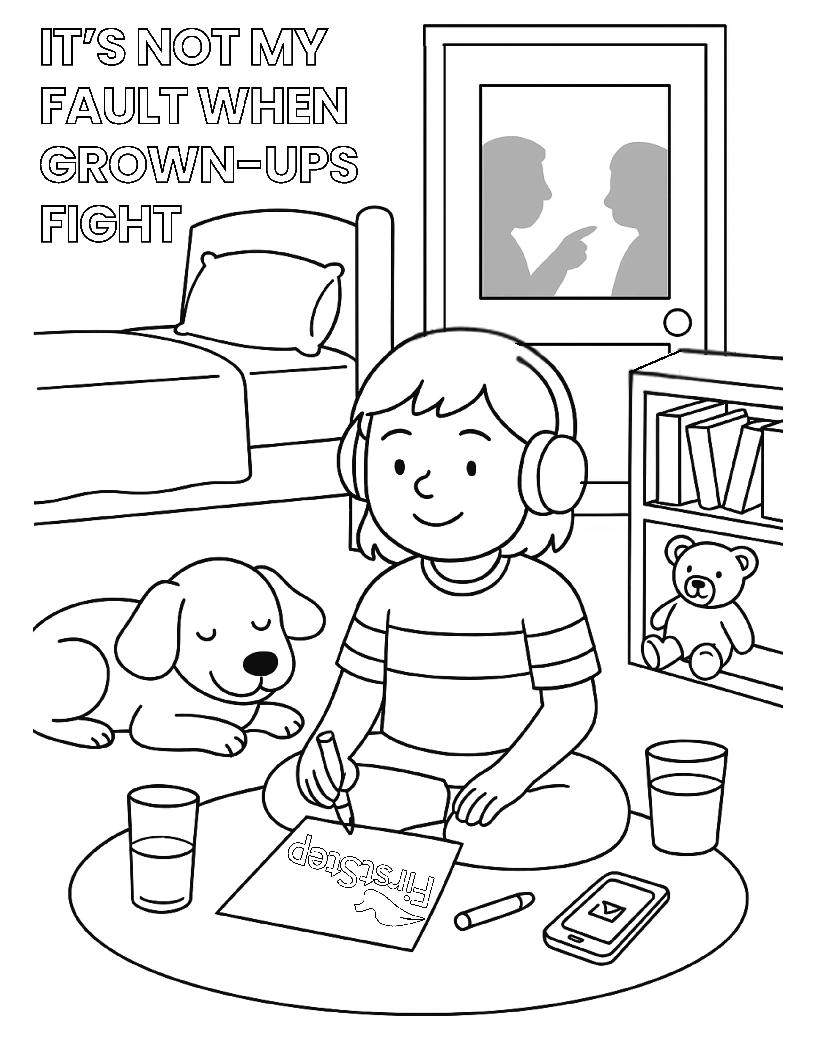
2) It’s Not My Fault When Grown-Ups Fight
Purpose:
Reduces self-blame; builds a safety plan
When:
Ages 5+, calm moments
Goals:
 Child chooses 2–3 safe actions during adult conflict
Child hears clearly “It is never your fault if/when grown-ups fight”
Prompts:
- “What is happening in this photo?” Identify that grown-ups are fighting. “What is this child doing to feel safe?”
- “Where could you go in our home to feel safe or calm?”
- “When grown-ups fight, what could you do to help feel safe?” “What should kids NOT do?”
- Answer: Kids don’t have to fix grown-ups’ problems. Trying to stop a fight can be dangerous and kids can get hurt.
- “What grown-ups could you call or text if you needed help?”
First Step offers safety workshops for youth and parents. Learn more at firststep-mi.org/youth-education
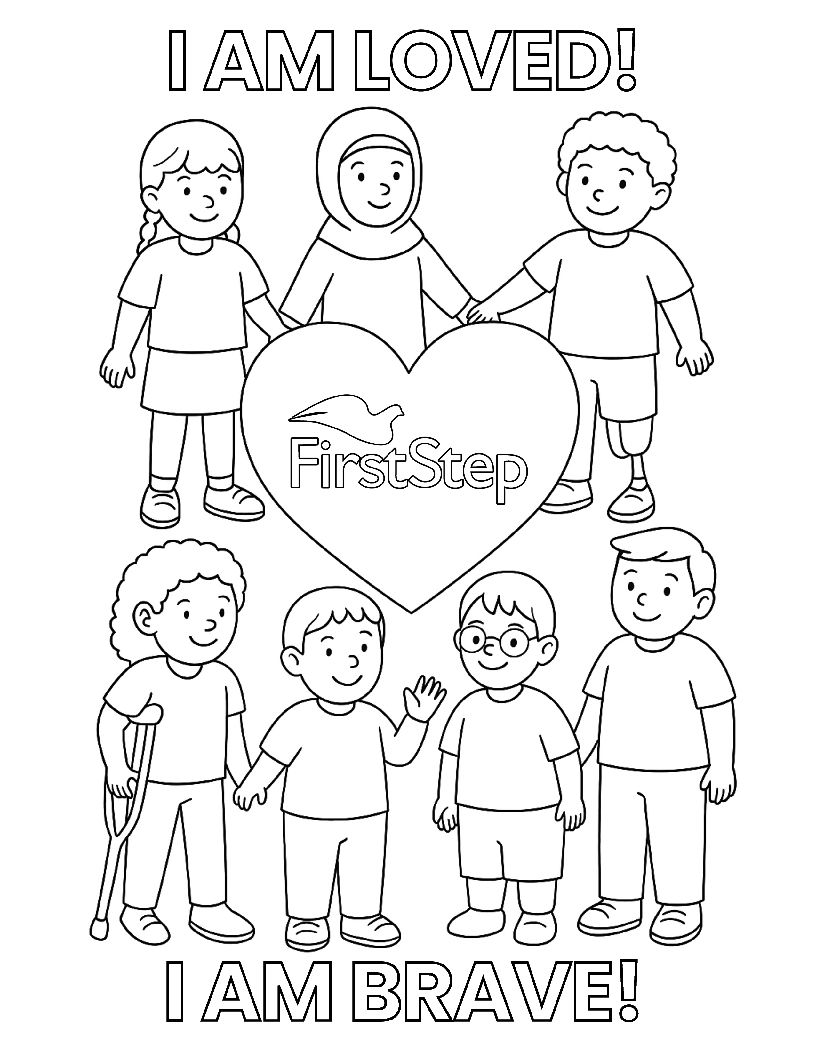
3) I Am Loved, I Am Brave!
Purpose:
Builds self-esteem, resilience, and connection
When:
Any age; at bedtime; before challenges (tests, games).
Goals:
✔ Child can say 2–3 positive things about themselves
✔ Child identifies an affirmation to say when upset
Prompts:
- “Tell me 3 things you love about yourself.” If the child struggles, share something you love about them!
- “Who helps you feel strong and brave?” and "What helps you feel brave and strong?"
- “What can we say when we have a bad day?” Create a mantra i.e., “I am loved! I am kind! I am brave!”
Practice:
- Say affirmations or mantra at bedtime or in the mirror
- Write or draw what the child says they love about themselves inside the heart on the coloring page
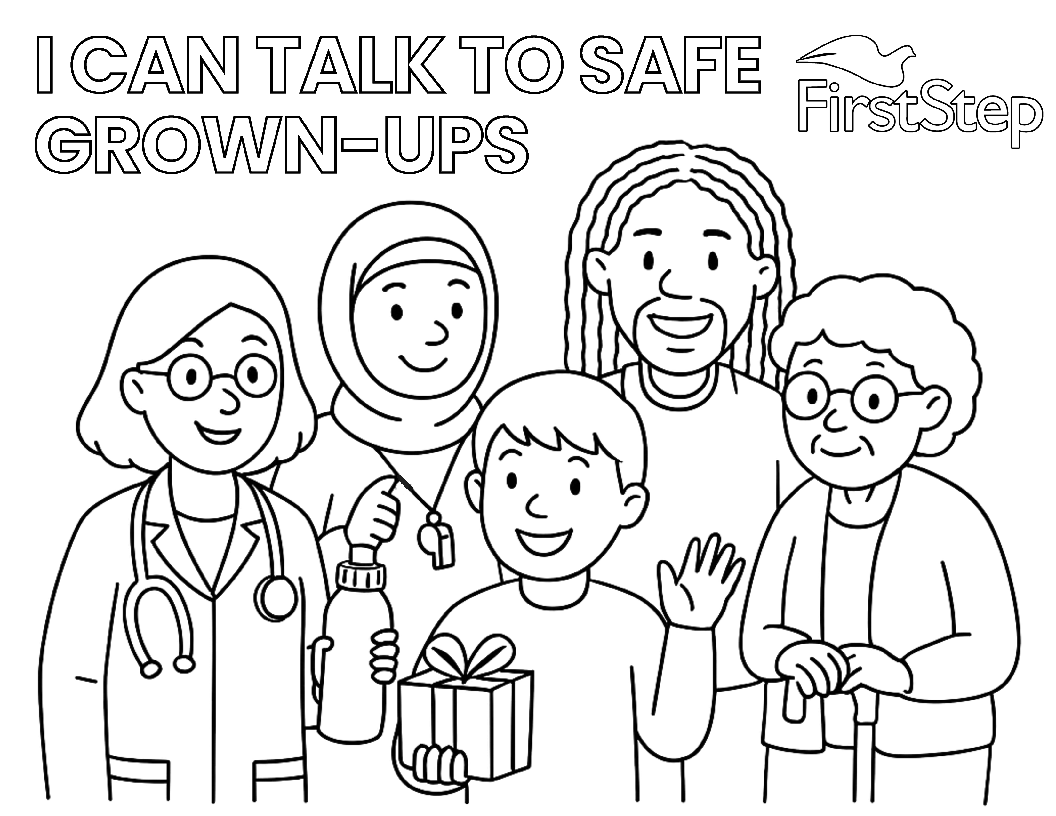
4) I Can Talk to a Safe Grown-Up
Purpose:
Increases help-seeking and safety planning
When:
Ages 3+, before new activities/schools or being away from home for a period of time.
Goals:
✔ Child can identify 3 safe grown-ups at home/school/community
✔ Child knows to keep telling until someone listens
Prompts:
- “Who is a grown-up?” Give examples to check for understanding: “Is your little sister a grown-up?” “Is your teacher a grown-up?”
- Talk about what makes a grown-up a “Safe Grown-Up”: A grown-up who listens to us, loves us, and helps us.
- “Can you name a safe grown-up you can talk to when you feel scared or sad?” or “Who could you talk to if something feels yucky or scary?”
- “If the grown-up doesn’t listen or help, what could you do?
- Answer: Keep telling! That is why we have more than one safe grown up on our list!
Practice:
- Build a “Safe Grown-Ups List” together
- Update this list when routines change (summer, moving, new school)
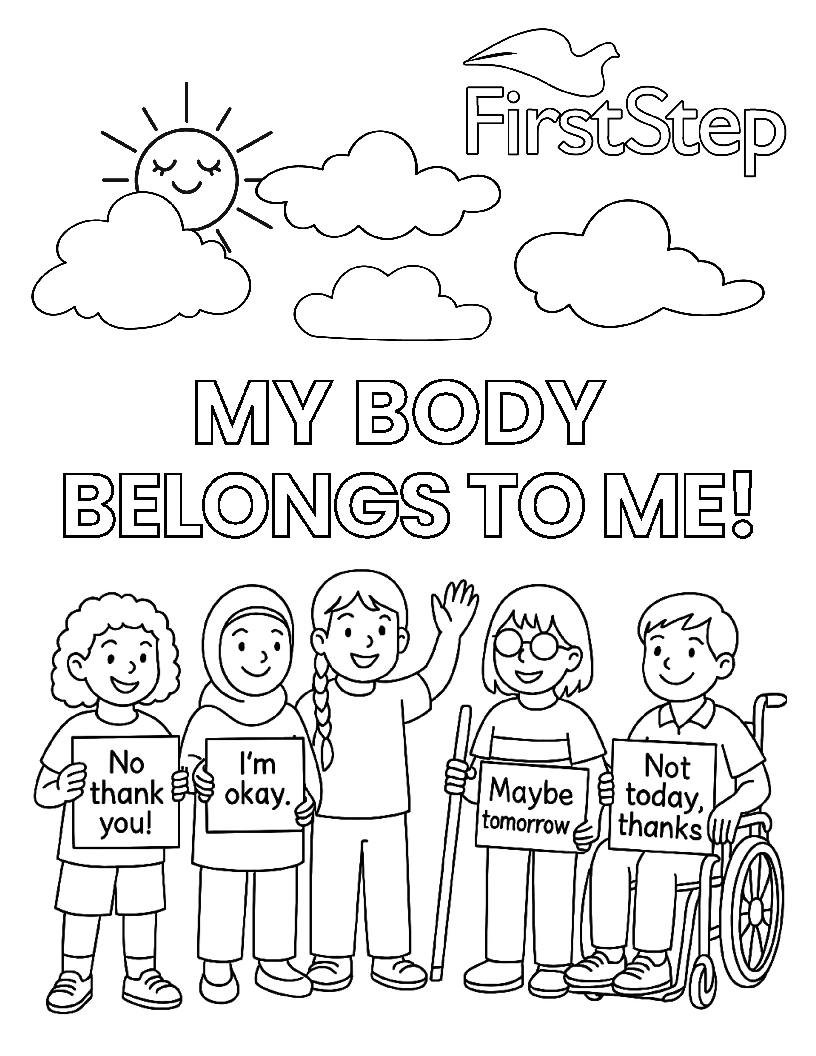
5) My Body Belongs to Me
Purpose:
Body autonomy, consent, boundary-setting
When:
Ages 3+, short calm moments; Before playdates, doctor visits, new activities
Goals:
✔ Child can say: “My body belongs to me.”
✔ Child can practice “No/Stop/I don’t like that.”
✔ Child can name 1 or more safe grown-ups (See “I Can Talk To a Safe Grown-Up” for help identifying what a “Safe Grown-Up” is)
Prompts:
- “What are ways to say no to a hug you don’t want?”
- Possible Answers: “No, thank you.” “Not today/not right now, thanks” “I don’t want a hug.”
- “When is it okay for grown-ups to help with your body?”
- Possible Answers: Sometimes safe grown-ups need to help us when we’re sick, hurt, or need help getting clean like a doctor or a caregiver/parent.
- Help the child identify who is a safe adult that should be helping them with bathing if/when they need it, or otherwise addressing private parts like a doctor, when another grown up is in the room.
- “Who is a safe grown-up you can talk to if you say no to touch and they don’t listen?”
Practice:
- Role-play asking for a high-five, and accepting “no”
- Offer choices to build autonomy (“brush teeth first or pajamas first?”)
Looking for more? First Step offers “My Body Belongs to Me” youth presentations for schools, groups, and community spaces. Learn more: firststep-mi.org/youth-education or visit firststep-mi.org/community-education to preview our presentation catalog for adults and professionals.
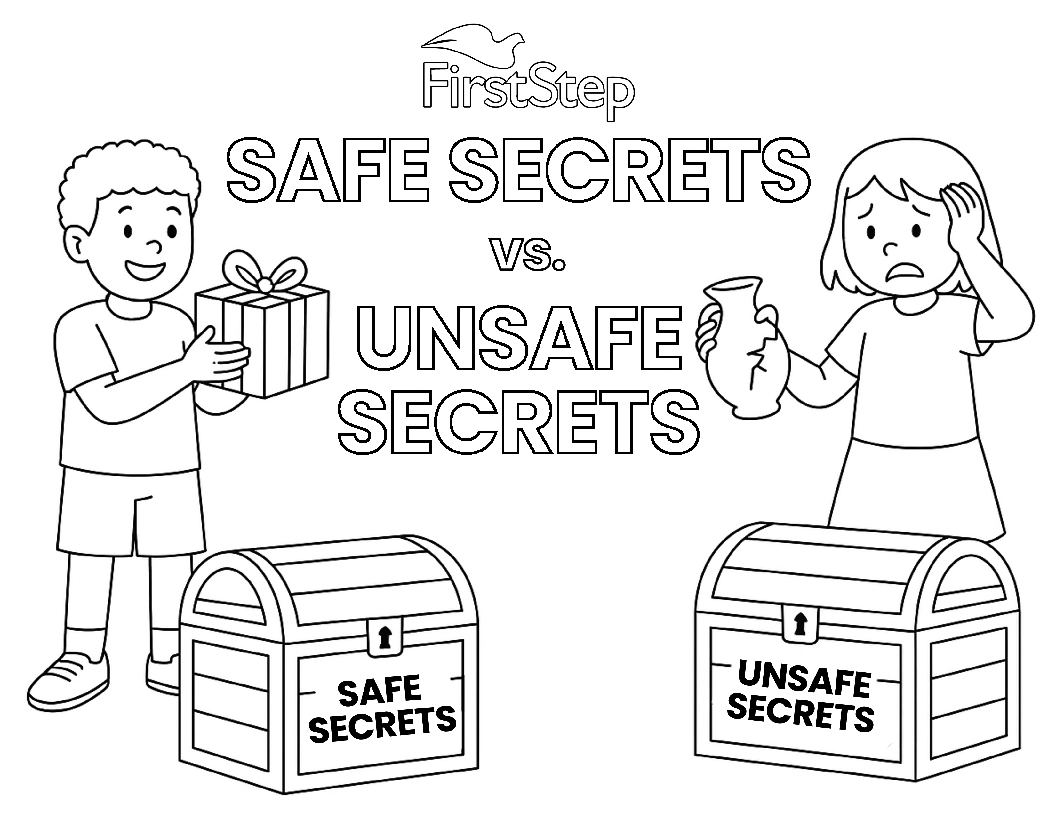
6) Safe Secrets vs. Unsafe Secrets
Purpose:
Separates joyful surprises from unsafe secrecy; helps children know when to tell.
When:
Ages 5+, before holidays/birthdays; anytime secrecy shows up.
Goals:
✔ A safe secret is like a surprise! Short, happy, harmless, and has an end
✔ An unsafe secret may make us feel scared, confused, has no end, or hurts someone
Prompts:
- “What is happening in this picture?”
- “Which kid here is keeping a safe secret? Why?” “Which kid is keeping an unsafe secret? Why?”
- Answer: The child on the left is happy and has a gift; The child on the right appears to be upset and is holding a broken vase.
- “Which secrets are okay to keep? Which should we tell a safe grown-up about?”
- “What can we say or do if someone tells us ‘Don’t tell’?”
- Answer: “I can tell a safe grown-up.” “Secrets that hurt are not okay.” or “Secrets that are forever are not okay.”
Practice:
- Ask: “Is this a secret or a surprise?”
- Make a rule: “We don’t keep secrets about bodies, feelings, or safety.”
- If someone says ‘This is our secret,’ practice saying: ‘I can tell a safe grown-up.’
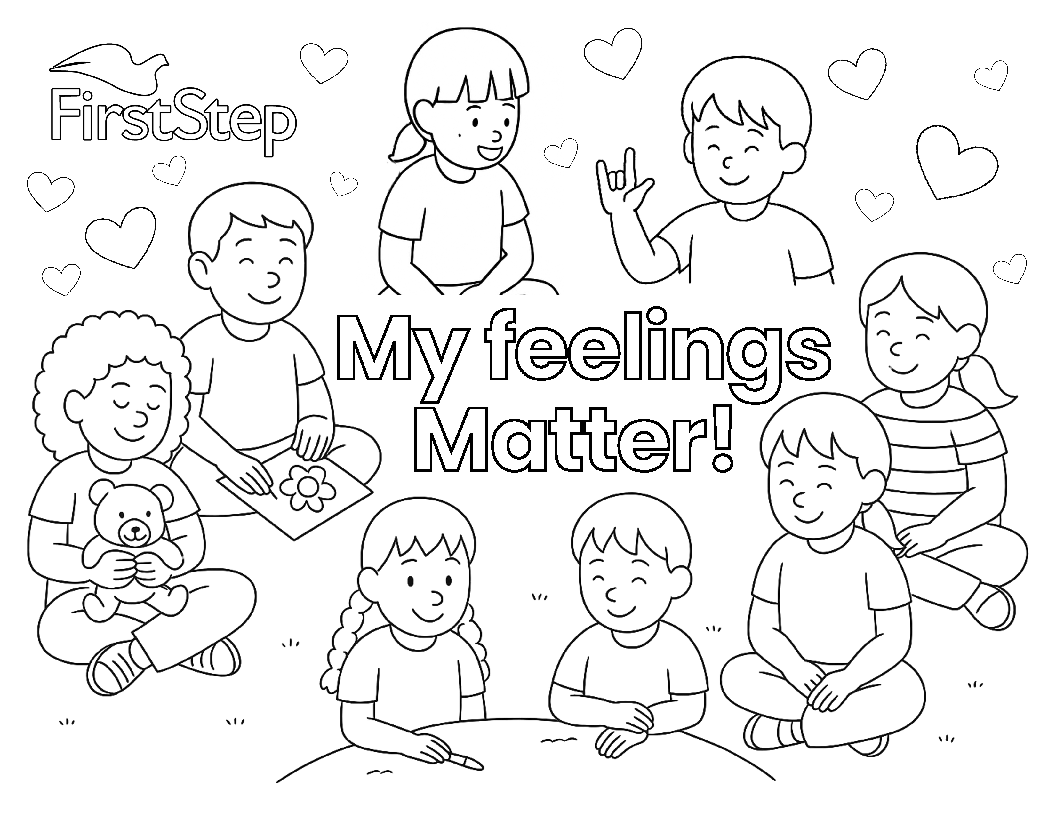
7) My Feelings Matter
Purpose:
Emotional literacy and healthy coping
When:
Any age; daily check-ins; increase frequency around transitions.
Goal:
✔ Child names 3+ feelings
✔ Child choose 2+ healthy coping skills
Prompts:
- “What feeling words do you know?” “When do you feel [insert feeling word]” or “What makes you feel [insert feeling word]” (happy, angry, sad, scared)
- “How do you feel right now?” or “What feeling word matches your face today?”
- “When’s the last time you felt angry?” “What did you do (when angry/with that anger)?” Discuss healthy ways to express to anger and unhealthy ways:
- Unhealthy is when we hurt ourselves, others, or things, with our bodies or our words
- Healthy includes things like exercise, journal, draw, drink a cold glass of water, talk it out, lay down, read, listen to music, distract yourself, play with a pet, etc.
- “What helps your body calm down?”
- Possible Answers: Breathing, coloring, squeezing a pillow, water break, movement, talking to a safe grown-up
- Check for understanding: “Is throwing things a safe or unsafe way to show anger?” “Is hitting someone when we’re mad a safe or unsafe way to show anger?” and “Is squeezing a stuffed animal a healthy or unhealthy way to show our anger?”
Practice:
- Create a coping menu: music, drawing, breathing, pet time, water break
- Model apologizing, calming down using the coping menu, and trying again
Quick “One-Minute” Scripts
- Body safety: “Your body belongs to you. You can say 'yes' or 'no' to touch.”
- Secrets: “Fun surprises are short. Scary secrets are not and maybe make us feel scared or sad. Unsafe secrets are not okay; we always tell a safe grown-up.”
- Conflict: “Grown-ups’ fighting is never your fault. What helps your body feel safe? Let’s practice it!”
- Feelings: “All feelings are okay. You can always tell me how you feel. I want you and others to be safe when we have big feelings.”
- Boundaries with peers: “You can leave any game or chat that doesn’t feel good. ‘No thanks’ is enough.”
- Online safety: “If a message or picture makes you feel weird or yucky, that’s a safety problem, we tell a safe grown-up.”
- Online Boundaries: “If someone sends you a message, picture, or request that feels weird, confusing, or yucky, that’s a safety problem. You can always show me or another safe grown-up.”
- Help-seeking: “If you’re worried, find a safe grown-up. You can always tell me.” Or “If something feels yucky or confusing, tell me or another safe grown-up.”
🚩
Possible Red flags of Child Sexual Assault
⚠️ Important ⚠️
The presence or absence of these signs does not prove abuse.
They are signals worth paying attention to.
- Sudden fear of certain people or places
- Regression (bedwetting, baby talk)
- Sleep problems or nightmares
- Sexualized behaviors beyond age norms
- Unexplained injuries and/or frequent urinary tract infections
- Withdrawal, secrecy, drastic mood changes
- Self-harm or talk of wanting to disappear
- New aggression or outbursts
If something feels “off,” trust your instincts. Document what you notice, increase supervision, and connect with support.

❤️🩹
Why Support Matters (Even After the Child Is Safe)
Children who witness or experience violence may carry feelings of shame, fear, and self-blame even after the danger has stopped.
Without support, this can lead to:
- Anxiety, depression, self-harm
- Difficulty in school
- Struggles forming healthy relationships
- Risk of future victimization or using violence
Getting help early can change the entire path of their life.

📍
Where to get help
First Step: 24-Hour Helpline 734-722-6800
- Safety Planning
- Counseling and Advocacy for Children and Their Families
- Caregiver support
- Emergency shelter and referrals
- Criminal Court Advocacy and Personal Protection Order assistance
- Education for youth, schools, and parents
Call the helpline to discuss or register for services, process your situation and concerns, and receive additional referrals and information. Services are free and confidential. Interpreter services available.
Other Resources: School counselor, pediatrician, therapist/counselor, faith/community leader trained in IPV/SA response, law enforcement, culturally or youth-specific organizations.
Not in Wayne County, Michigan?
Find your nearest Domestic Violence or Sexual Assault program:
Michigan coalition: mcedsv.org/resources
National Domestic Violence Hotline: 1-800-799-SAFE or thehotline.org
RAINN (sexual assault support): 800-656-HOPE or rainn.org

Want First Step to Visit Your Child’s School or Program?
We offer free age-appropriate safety education:
✔ My Body Belongs to Me (K–5)
✔ Keeping Kids Safe (K–5)
✔ Expect Respect (Teens)
✔ Parent workshops and school faculty trainings
Learn more or request a presentation: firststep-mi.org/youth-education or visit firststep-mi.org/community-education to preview our presentation catalog for adults and professionals.
For custom trainings, visit firststep-mi.org/trainings.